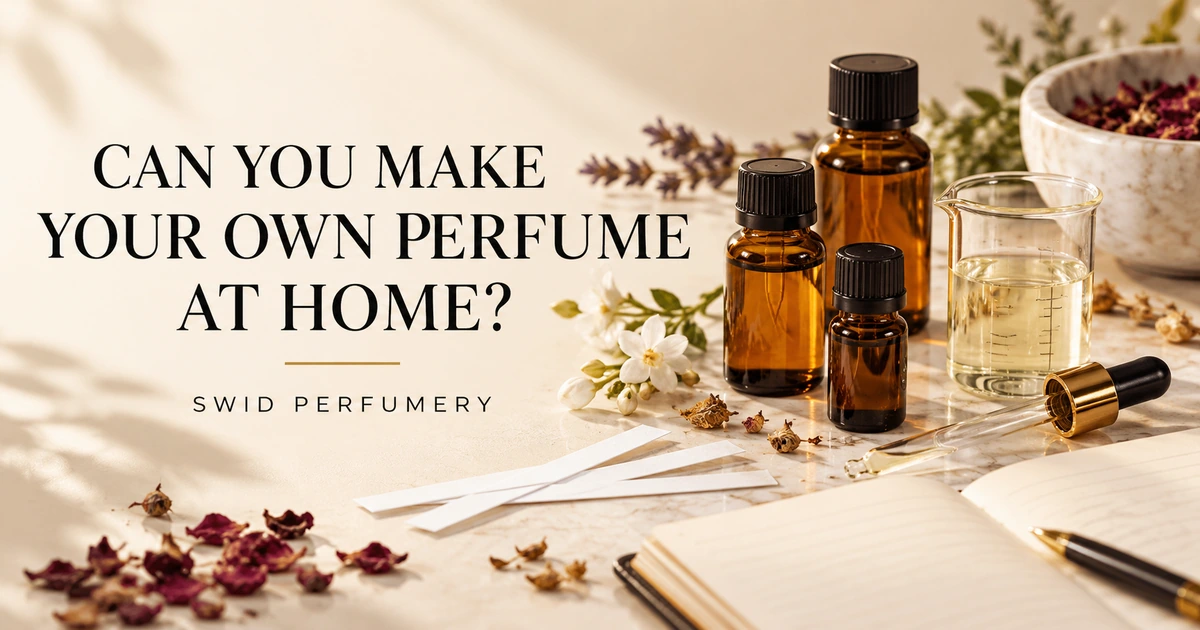
Yes, you can create a custom perfume at home. However, a wearable fragrance needs more than a pleasant mix of scented liquids. You must choose compatible ingredients, measure carefully, and check safe-use guidance before wearing a formula.
For a creative hobby, home blending can be rewarding. In contrast, a custom-perfume builder offers a simpler route when you want a finished scent without buying tools and raw materials.
First, Decide Which Experience You Want
- For experimentation, try small scent studies on paper and keep notes about what you smell.
- Instead, choose a guided custom fragrance when you want a finished perfume built around your preferences.
- For a ready-to-wear option, compare finished perfumes by their listed scent profile, size, and format.
These routes serve different goals. DIY blending teaches you about scent, while a ready-made custom fragrance saves you from formulating the base yourself.
What Do You Need to Start at Home?
- First, use materials sold for fine fragrance or leave-on cosmetic use, with clear supplier directions.
- Next, prepare clean glass vials, disposable pipettes, scent strips, labels, and a small accurate scale.
- Also, keep a notebook for measurements, dates, and impressions as each trial develops.
- Finally, choose a suitable perfumery base only after checking that it works with your ingredients and intended use.
You do not need a large collection to begin. Instead, start with a few materials that you can identify and use according to their supplier guidance.
Next, Build a Small Scent Trial
- First, write down three scent qualities you enjoy, such as fresh, floral, woody, musky, or sweet.
- Next, smell each material on a scent strip by itself. Record the opening and the later dry-down.
- Then, combine a very small amount of just a few materials in a clean, labelled vial.
- Afterward, close the vial and let the blend rest. Smell it again later because the balance may change.
- Finally, change one part at a time and record every adjustment. That makes each new version easier to compare.
Measure by weight whenever your materials and tools allow it. In contrast, counting drops can give inconsistent results because droppers and liquids vary.
Top, middle, and base notes can help you describe how a scent develops. However, those labels do not provide a complete formula or tell you whether an ingredient suits skin use.
Safety Comes Before the Scent
Natural does not automatically mean safe. For example, the U.S. Food and Drug Administration warns that some plant-derived materials can irritate skin, trigger allergies, or react badly with sunlight. Read the FDA’s guidance on essential oils and aromatherapy before applying botanical materials to your skin.
Instead, check the supplier’s directions and any relevant limits for leave-on fine fragrance. Choose ingredients with guidance for the exact way you plan to use them.
- Never apply concentrated essential oils or an unverified blend directly to your skin. Also, do not guess a dilution percentage.
- Because alcohol-based perfume can ignite, keep it away from flames, heat, and sparks. Likewise, work with good ventilation.
- In addition, label every vial and store it away from children and pets. Keep fragrance materials separate from food and drink.
- In short, use glassware reserved for fragrance work, not kitchen utensils or drink containers.
A home recipe cannot guarantee skin safety on its own. Therefore, keep unverified trials on scent strips until you can confirm the ingredients and final concentration suit leave-on fragrance use.
Why Can a Homemade Perfume Be Hard to Get Right?
Professional perfumery combines creative choices with careful ingredient selection and safety assessment. The International Fragrance Association’s overview of fragrance creation explains why trained perfumers work with many materials and evaluate the finished composition.
Still, a note list is only a guide to a fragrance’s character. It does not reveal every ingredient, its exact amount, or how a finished formula will behave on your skin.
As a result, a simple home recipe rarely recreates a complex commercial perfume exactly. A note such as vanilla, rose, or oud also does not prove that the material comes from a specific natural source.
A Custom Perfume Option Without the Guesswork
For a guided route, explore the SWID custom-perfume builder. It lets you choose an alcohol-based or oil-based fragrance, select a bottle, and add complimentary name engraving.
The current product description says you can choose one oil in 30 ml or combine up to four oils in 50 ml or 100 ml. However, the same page also lists a 60 ml size elsewhere, so confirm the selectable size and bottle styles in the live builder before ordering.
You can also browse the SWID oil library, which currently displays 298 entries across inspired-by fragrances and scent-note options. Availability varies by entry. For example, its notes section currently shows Mukhallat Damas Rose, White Oud, and Rose Vanilla.
These are SWID fragrance choices, not raw perfumery materials or original designer-branded perfumes. Instead, treat the inspired-by options as independent SWID selections; they do not promise an exact formula match or imply a brand affiliation.
For local shoppers, visit SWID Perfumery at 953 Main St, Paterson, NJ 07503, to explore scent options in person. Check the contact page for current store hours.
For shoppers farther away, use the online builder or browse the custom-perfume collection. The product page lists online shipping and store pickup; check the available options for your order.
Frequently Asked Questions
Can I make perfume using only essential oils?
Sometimes, but you still need materials suitable for leave-on skin use and the correct safe-use levels. Natural ingredients can cause irritation too, so do not skip supplier guidance.
Will homemade perfume always cost less?
No. In addition to ingredients, you may need tools and several trial batches. For a one-off finished fragrance, a custom builder may reduce the setup effort.
How long should a homemade blend rest?
There is no universal waiting period because formulas differ. Instead, follow reliable supplier guidance and assess the blend after an appropriate rest.
Can I make a perfume that smells exactly like a designer fragrance?
Not from a simple recipe or note list alone. Moreover, SWID’s inspired-by oils are separate products, not original branded formulas.
Can I wear my first blend on my skin?
Not until you confirm that each ingredient and the final concentration meet safe-use guidance for leave-on fragrance. Therefore, beginners should keep unverified trials on scent strips.
In Short, Can You Really Make Your Own Perfume?
Yes, you can start exploring perfume creation at home. However, careful ingredients, accurate measurement, and safe-use limits matter more than a pretty bottle or a quick recipe.
If your main goal is a personal scent rather than a formulation project, the SWID custom-perfume builder gives you a guided way to explore one fragrance or a blend. Browse the oil library first, then check the builder for current options and eligible engraved bottles.
 Luxury Fragrance House